
Let's start with a sobering stat: most industry benchmarks put cold email response rates between 0.5% and 5%. Yet, with the average professional receiving 121 emails daily, many campaigns fail to even hit that 0.5% floor. The competition for attention is brutal, but the data reveals a clear path forward. By 2026, generic blasts are dead. The winners will master hyper-personalization, precision psychology, and relentless optimization. Here’s the research-backed blueprint.
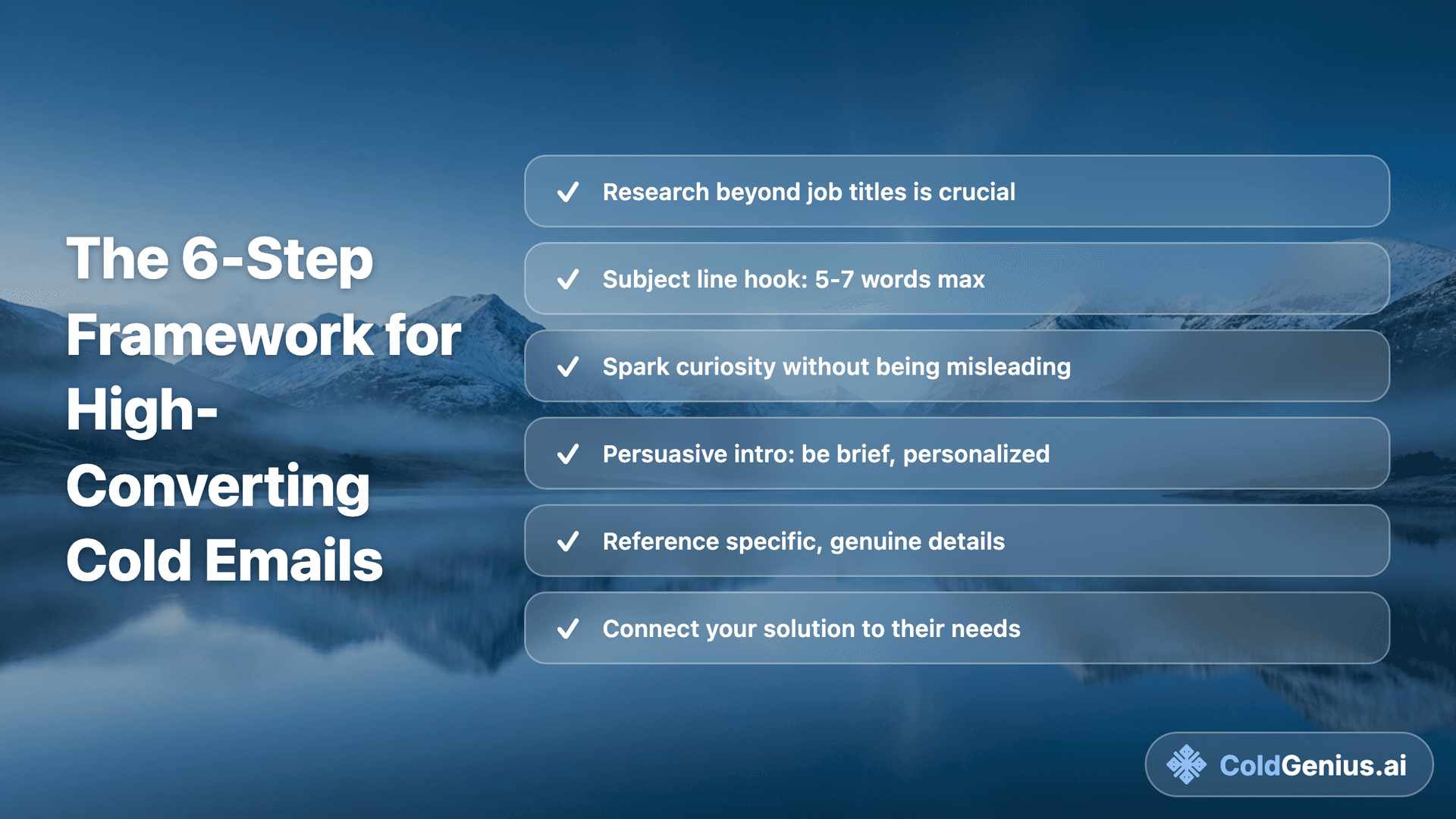
The 6-Step Framework for High-Converting Cold Emails
Effective cold emails are a sum of meticulously crafted parts. Overlooking one element can crater your results. Follow this structured process.
Step 1: Research That Goes Beyond Job Titles
Audience research is non-negotiable. Your ideal customer profile (ICP) must include psychographic, demographic, and technographic data. Go beyond basics: gather intel from LinkedIn, company websites, and industry reports. Crucially, segment your prospects by vertical to tailor your offer. The goal is to understand not just who they are, but their specific, emotional pain points.
Step 2: The Subject Line Hook (5-7 Words Max)
As David Ogilvy noted about headlines, your subject line is 80% of the battle. Keep it concise to avoid clipping. Spark curiosity without being misleading. Examples that mirror natural speech work best:
- Question about [company name]
- Admire what [company name] is doing
- [First name], interested in connecting?
- Introduction through [name of connection]
Step 3: The Persuasive, Personalized Intro
Brevity reigns. Openings should be one to two sentences, referencing a specific, genuine detail. "Love what your company is doing" is a red flag now. Effective personalization taps into:
- A recent company product release or funding round
- An insight from the recipient's article or presentation
- A genuine congratulation on a promotion or award
Step 4: The Body: Build Rapport with Proof
Here, you connect your solution to their pain point. The body must be recipient-focused and include:
- A clear description of their pain point
- One specific benefit you provide
- Quantifiable results (e.g., "increased revenue by 50%")
- A testimonial or evidence of past success
Research indicates the optimal length is often between 20 and 50 words. Be concise, but don't sacrifice necessary detail for technical or executive audiences.
Step 5: The "Interest" Call-to-Action
Data from Gong Labs is definitive: the "Interest CTA" outperforms all others. "Would you be interested in learning more?" yielded a 30% booked meeting rate, double that of more specific CTAs. It's a low-commitment question that invites a simple "yes" or "no," respecting the recipient's time.
Step 6: The Professional Signature
A complete signature (name, title, company, contact info, LinkedIn) builds trust—57% of professionals say so. Adding a profile picture via Google Workspace can help you stand out, as 60% of mid-sized businesses use Gmail. Be mindful that excessive links/images can sometimes trigger spam filters, so test.
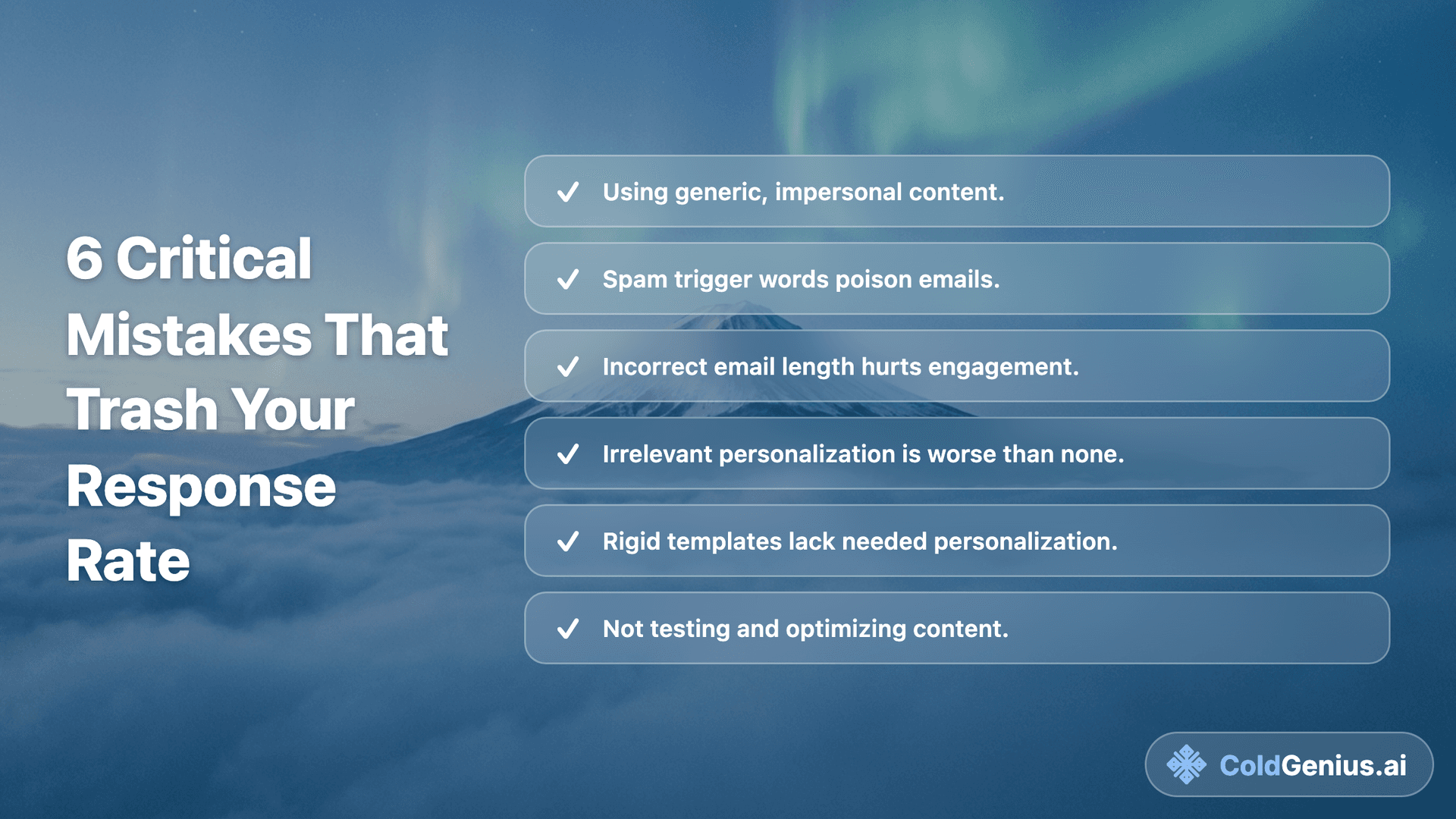
6 Critical Mistakes That Trash Your Response Rate
Knowing what not to do is half the battle. Avoid these pitfalls at all costs.
1. Writing Generic Content
With 121 emails hitting an inbox daily, blandness is fatal. Causes include absent or shallow personalization, untargeted offers, overly long body text, and jargon-filled language. Focus on the reader, not your features.
2. Using Spam Trigger Words
These words are poison. Avoid categories like:
- Sales Jargon: "Guaranteed," "Best price," "Increase sales"
- "Pressure" Words: "Act now," "Last chance," "Don't hesitate"
- Misleading Language: "Risk-free," "No obligation," "You're a winner"
Also, avoid attachments and too many links in initial emails.
3. Getting the Length Wrong
The 20-50 word guideline is a strong starting point, but it's an average. The only way to know what works for your audience is through A/B testing. Start short, but don't be afraid to test longer, more detailed emails for specific segments.
4. Irrelevant Personalization
Bad personalization is worse than none. Avoid empty platitudes like "Hope you're having a good Monday" or vague technographic spies like "Are you enjoying using Hubspot?" Personalization must be specific, honest, and relevant to your offer.
5. Relying on Rigid Templates
While templates provide a framework, they often fail by lacking enough personalization, using vague value propositions, or having CTAs that are too specific or too general. A template should be a guide, not a cage.
6. Not Testing Everything
This is the cardinal sin. You must A/B test:
- Subject lines
- Opening lines
- Offer descriptions
- Case studies used
- Call-to-action phrasing
- Email length
Data is your only true guide. A single follow-up email can boost campaign response rates by 220%, but data shows a sequence of three total emails performs best.

The future of cold email isn't better templates—it's no templates at all. The next evolution is hyper-personalization at scale, where each email is a unique artifact crafted from deep prospect research, not a fill-in-the-blank exercise. This means referencing a prospect's recent blog post analysis, their company's specific funding milestone, or a nuanced insight from their LinkedIn activity—at the volume of thousands of emails.
This is where AI transitions from a simple automation tool to a core research and writing partner. The goal is to automate the process—the data gathering, the personalized writing, the relentless optimization—not just the sending. The outcome is a campaign where every message feels human-written because it's guided by real data and crafted for one person, not a segment. This approach directly tackles the biggest challenges of 2026: inbox saturation, AI-detection filters, and the demand for genuine relevance.